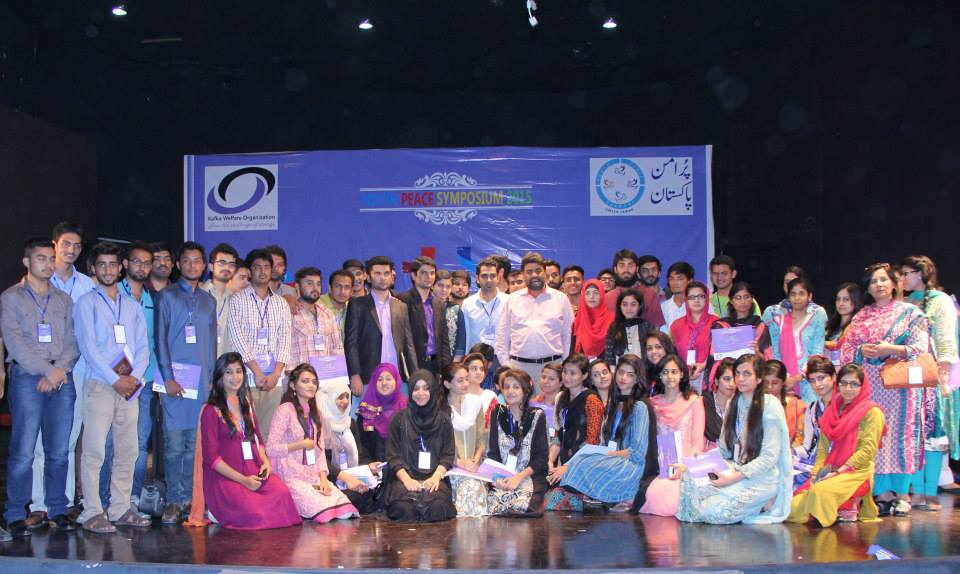
Umair’s Founding of the Kafka Welfare Organization
Before entering the sport-for-development sector, Umair Asif was a social activist who started a non-profit organization during his undergraduate studies called Kafka Welfare Organization. As stated by their website, Kafka’s mission is to “work for the development & empowerment of socio-economically disadvantaged & vulnerable people, especially women in Pakistan.” The non-profit has organized campaigns to create awareness about a variety of social issues, which include child marriages, gender-based violence, sexual reproductive health, and education reform.
“We initiated a peace campaign between 2013 to 2015 and organized three National Youth Peace Festivals. At the time, that was really challenging because Pakistan was facing a lot of suicide attacks from the Taliban, and it was very difficult to organize […] The youngsters, especially from different regions —some from backward or underdeveloped areas — feel low and think they are not part of the system. And it’s also true, sometimes their voices are not heard.”
“We brought them to a single platform and the idea was to listen to them and give them an opportunity to talk about their issues — and we brought politicians and influential [figures] at the same platform. Even if they are girls, they have different issues —violence against girls and women, the access to education. Our idea was always to help out young people in all possible ways.”
Over the last seven years, Kafka has engaged almost 10,000 youngsters in their programs. The organization has benefited from the support of political leadership and relevant departments within the government of Pakistan, who have actively participated in their policy dialogues and forums.
The Use of Sport for Social Change
Umair was initially introduced to the use of sport for social change when he was selected to become part of the Young Leaders program created by the United Nations Office on Sport for Development and Peace. This program provided Umair a toolkit to design curricula that lead to social outcomes while considering local contexts, enabling him to get involved with projects like Football for Peace South Korea, which aims to socially integrate North and South Korean children through soccer.
Guided by Umair’s leadership, Kafka uses sports as a development tool to prevent violent extremism among youth by enhancing tolerance and resilience. Young people are also taught life skills, as well as social and moral values through team-based inclusive sports activities.
This unique promise of sport prompted him to pursue a PhD at the University du Québec à Montreal, where he is currently writing his thesis on the use of sport for development and peace, as well as for the prevention of violent extremism (PVE).
“I included [sport] in my work because it is an innovative way of engaging people in community mobilization or community engagement. One of the challenges always is ‘How do you mobilize people?’ And sport is attractive and powerful to engage people, everyone is interested to play. And even if they don’t play, they are interested just to observe. The other tools are dialogue or workshop training —people are not interested sometimes and may have different doubts, but when it’s about sport, everyone is somehow willing to engage.”
Countering Extremism Through Primary Prevention
Countering extremism is a top priority around the world which requires a nuanced approach that respects human rights, avoids stigmatization, and addresses the underlying grievances that may fuel radicalization. Doing so requires significant financial, technical, and human resources, as well as effective cooperation among governments, civil society organizations, communities, and international partners.
“In Pakistan locally, it’s more sectarian and ethnic extremism —you can say sectarian violence or ethnic violence is based on them. Globally, [extremism] has many types. Political radicalization, or political violence, is there —and if we talk about jihadi extremism, there are other different types. But in Pakistan, the conflict is more between different ethnic groups and religious sects.”
Violent extremism became such a serious issue in Pakistan that, in 2014, the military initiated Operation Zarb-e-Azb against extremist groups to normalize peace conditions in affected areas in Pakistan.
However, the problem around youth involvement in violent extremist activities continues to persist, which can be reinforced by political grievances, unemployment, poverty, and/or trauma.
Kafka focuses on violent extremism prevention through sports-based activities by embracing primary prevention, which promotes social inclusion and strengthen resilience against violent extremist ideologies.
“In primary prevention, we build resilience in communities so that they already have some strength when someone tries to engage them in radical activities.”
The benefits of employing sports-based social programs are widely documented: from easing the growth of community networks, to reducing stress and anxiety, as well as facilitating conflict resolution.
Furthermore, according to Umair, sport can also be an effective way to reintegrate formally radicalized individuals.
“I was evaluating a program in my masters and they de-radicalized some people through sports, so it works. There are many projects in Africa in which they are reintegrating child soldiers.
Moving Forward
Umair is currently busy pursuing his PhD at UQAM researching the use of Sports for Development and Peace (SDP) and violent extremism prevention. Looking ahead, he is looking for ways to increase Kafka’s outreach in a more sustainable way.
Additionally, Umair is of the opinion that there are certain collaborative measures that can be improved upon.
“90% of researchers are from the Global North and the majority of projects are implemented in Global South. I think that something is missing there —it’s the same with other sectors also. International organizations are working in Pakistan; they design their programs, they bring things. Somehow, those things are not in resonance with local context or local issues. I think that needs to be changed. Those things should be designed with the involvement of locals, local academics, local development practitioners because those things are very important.
In addition to designing programs that are more sensitive to local contexts, Umair also believes that NGOs can better empower organizations, like Kafka, by providing more resources and teaching team members governance and interpersonal skills.
“Partnerships are already there, but somehow local organizations have problems with the resources. Their structure is not developed and that needs to be changed. Maybe by the involvement of Pakistan’s government, by the involvement of international NGOs […] If you’re not empowering local organizations, then something is really missing because that part is linked with the impact.
 Elixir Sports
Leave a comment